
Streaming maturity and video sharing grows up: Glance reveals the forces reshaping TV and video at MIPCOM 2026
12 OCTOBER 2026
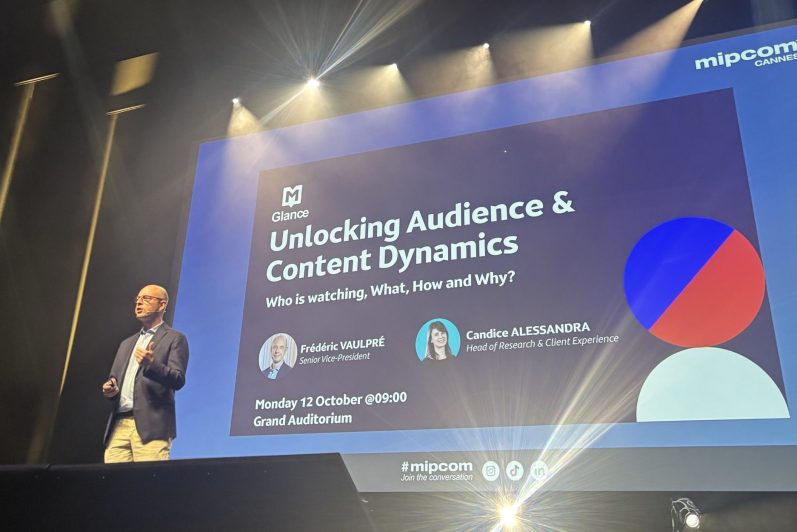
In the hour-long session, Glance’s Senior-Vice-President, Frédéric Vaulpré, drew on official audience measurement data and SVOD catalogue tracking across key markets to examine how SVOD platforms and broadcasters are increasingly competing and cooperating in a world of hyper distribution. He was joined by Head of Research and Client Experience, Candice Alessandra, who shared the key international trends shaping Scripted and Unscripted content.
Glance, shared its MIPCOM 2026 keynote session exploring ‘Unlocking Audience & Content Dynamics: Who is Watching, What, How and Why?’ at the Palais des Festivals, Cannes.
"Streaming has entered its maturity phase, and the line between broadcasters and platforms is blurring. With new content slowing, platforms are growing their catalogues through broadcaster partnerships and moving closer to the TV model, while the ad tier puts them in direct competition for advertising. Yet live events, sports for example like the FIFA World Cup, show TV can still unite nations. In this world of coopetition, the winners will be those who understand who is watching, where and why by having an accurate understanding of audience drivers." said Romy Nicolas, International Research Manager at Glance
What's on offer: SVOD and broadcaster coopetition
Vaulpré opened by showing that content supply and audiovisual consumption feed each other, before revealing that the new content offer is shrinking across the board. Across 48 territories, new series on linear TV fell by 12% between January and September 2026 compared with the same period in 2025. The trend is similar on SVOD, where new content in global platform catalogues dropped by 12% on Netflix, 41% on Disney+.
Yet SVOD catalogues continue to expand, fuelled by broadcaster partnerships. In France, Netflix’s catalogue grew by 61% content hours in June 2026 with the contribution of TF1+, while Prime Video’s grew by 49% with content from M6+ and france.tv. Indicating that SVOD is moving closer to the traditional TV model, with content historically less common on streaming platforms.
How audiences are watching: linear TV challenged, but holding its ground
The session then turned to linear TV; an established model being challenged. Daily viewing time fell in every international market analysed in the first half of 2026 compared with the first half of 2025, with the steepest drop in the United Kingdom, down 9 minutes to 2 hours. Italy remains, in Western Europe, the biggest TV-viewing nation at 3 hours 32 minutes per day.
In the United States, broadcast networks have proved much more resilient than cable. Between January 2024 and June 2026, broadcast’s share of total video eased from 24.2% to 19.8%, while cable fell from 27.9% to 19.5%, and streaming climbed from 36.0% to 48.5%.
This shift is reflected in advertising revenues: in a declining TV advertising market, broadcaster video on demand (BVoD) is gaining share, rising from 23% to 29% of UK TV advertising revenues between 2023 and 2025, and from 9% to 14% in France. Meanwhile, SVOD players’ advertising revenues in France have grown from around €23 million in 2023 to around €200 million in 2025.
As streaming matures, consumption is increasingly driven by new seasons of established shows rather than new launches. In Spain, returning seasons now account for 58% of Netflix Top 10 viewing, up from 35% in 2023, while new launches have fallen from 65% to 33%.
Why live still matters: sport as the ultimate battleground
Vaulpré asserted that live programming is still strong, with sports events continuing to bring some of the largest TV audiences. The 2026 FIFA World Cup reached a cumulative 2.6 billion viewers in China, while 19.9 million viewers in the UK watched England’s semi-final, the highest UK audiences since the Euro 2020 final in 2021. In Spain, 16.6 million viewers watched the extra time of the final, the second most-watched TV event ever, and in Norway, 1.95 million viewers, a 98% market share, tuned in to watch Norway beat Brazil, the country’s best TV audience since the 2010 Eurovision Song Contest final.
Sport is also one of the main priorities for platforms, with partnerships including the UEFA Champions League on Paramount+ in the UK, the NHL on Prime Video in the United States and Formula E on Disney+ worldwide.
Looking ahead, Vaulpré highlighted three points to watch before the end of the year: major upcoming titles including Warner’s Harry Potter series and Blade Runner 2099 on Prime Video; the fusion of content via consolidation with the ITV and Sky, and Warner and Paramount deals in particular; and the US midterm elections, with a strong forecast for advertising investment.
The most impactful trends & content to watch out for
Alessandra then shared a complementary content perspective, delving into the key trends shaping Scripted and Unscripted content, opening with the series that travelled the most over the past year.
Drawing on Glance's NoTa platform, which tracks more than 10,000 new TV show launches a year across 48 territories, Alessandra revealed that the United States and the United Kingdom remain the top two exporters of scripted series. France is now level with Turkey in third place: despite lower commissioning overall, France has increased both its scripted exports and its number of new original series. Together, these four countries account for 60% of all scripted series exports.
The season's most-travelled titles changed almost entirely from last year. Streaming originals are increasingly finding homes on local TV channels and platforms, and coproductions and international collaborations are on the rise.
Scripted series
Three scripted trends stood out. Ecological drama has been rising steadily for four years. It weaves climate change, biodiversity and environmental activism into genres ranging from accessible crime procedurals to dark psychological thrillers, often with young adults at the centre.
A second wave of series champions ordinary heroes who use their knowledge and determination to take on powerful systems, institutions and individuals in education, finance and the justice system. The tone ranges from inspirational and comedic to darker themes. Also food is becoming a surprisingly versatile ingredient in crime stories, with kitchens providing the backdrop for everything from family drama to adult animation.
Unscripted series
In unscripted, the traditional top three exporters, the UK, US and the Netherlands, are being challenged by other territories, with their combined share of format adaptations down five points to 58%. Celebrity-led formats that test talent psychologically or intellectually rather than physically travelled well, and Nordic countries stood out as both providers and importers.
Alessandra pointed to three trends shaping the genre. Courtroom formats are borrowing from comedy, fiction, social experiments and talk shows. A wave of ‘militarised’ formats draws on survival, combat, military training and global conflicts to produce sometimes uncomfortable viewing. Also on a more optimistic note, video podcasts, creator-led formats and vertical content show talent and distribution models moving between platforms that once operated in very separate worlds.
Across both scripted and unscripted, the trends Alessandra highlighted reflect today's concerns, from the environment to geopolitical conflict, while content, talent and distribution models increasingly move between platforms that once operated in very separate worlds.
Blending official audience data with SVOD catalogue tracking and international content insight, the session gave attendees a clear picture of who is watching, what they are watching, how they are watching it and why certain content continues to resonate.
From shrinking content pipelines and broadcaster-platform partnerships to the rise of the ad tier and the enduring power of live sport, Glance showed that in an era of maturity, the battle for attention will be won by those who combine the strengths of TV and streaming.
Glance delivers official ratings for more than 7,000 channels, working with more than 50 data providers and 170 major clients, streaming services and production studios worldwide to turn complex audience data into actionable insights. Its team of experts analyse audience viewing data, for a variety of clients across the globe, using robust methodologies.